
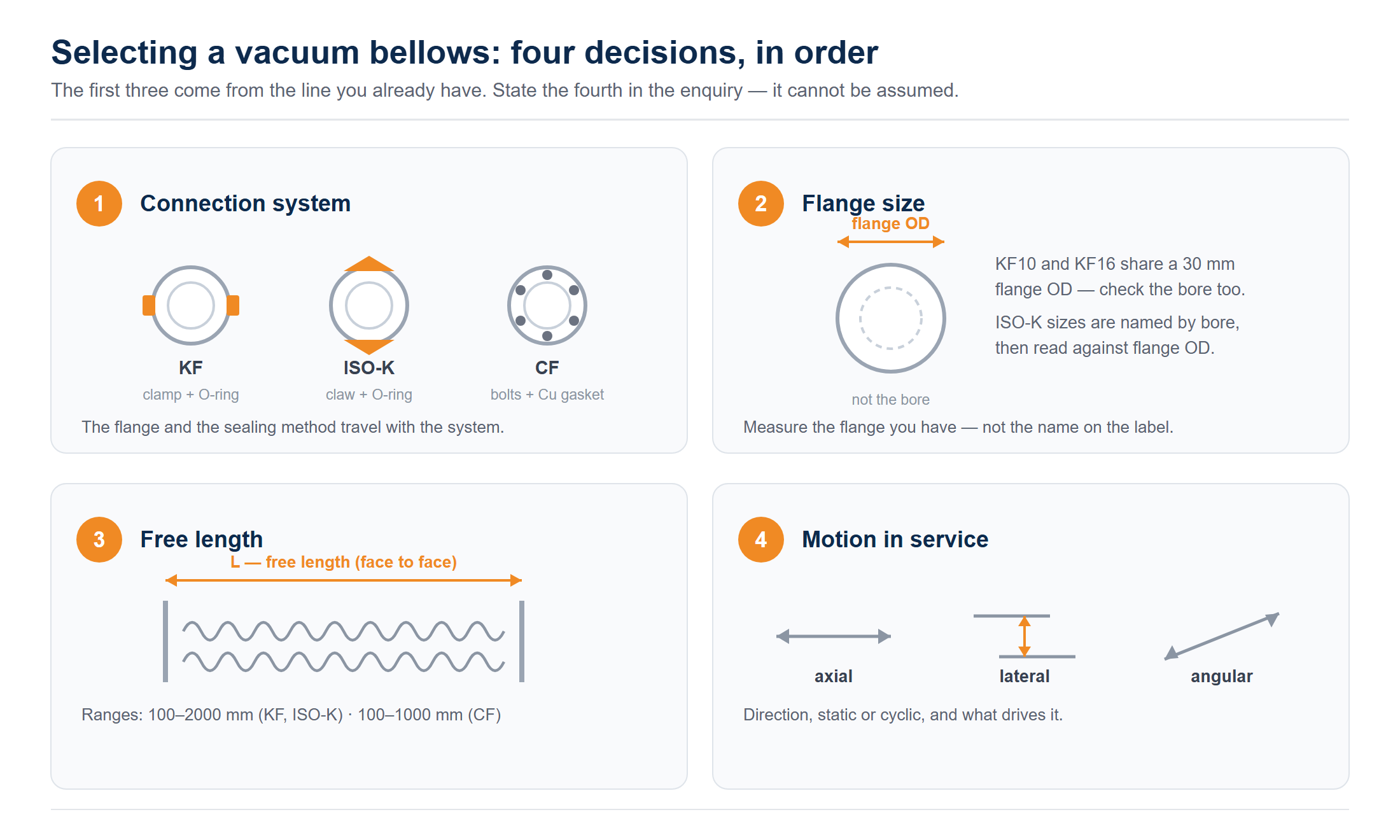
Quick answer. A vacuum bellows is ordered from four decisions, in this order: which connection system the two ends must mate with, which flange size each end has, how long the assembly must be between the flange faces, and what motion it has to absorb in service. Get the first three from the line you already have; the fourth is the one that turns a correct part into a failed one, so state it in the enquiry instead of assuming a standard value. Everything else — material, sealing hardware and cleaning — is confirmed against the working conditions.
What a bellows does in a vacuum line
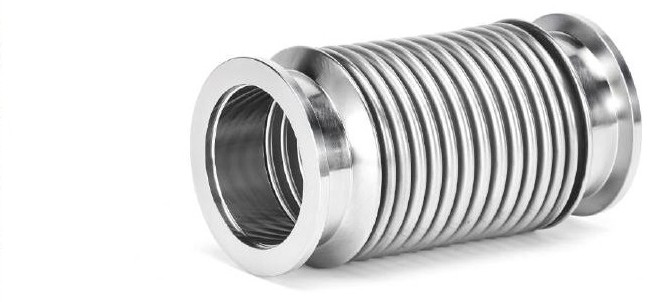
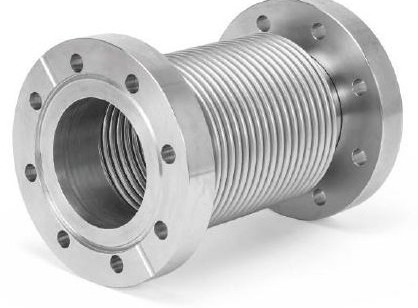
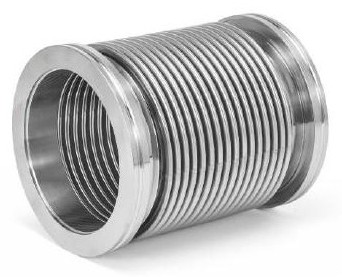
A bellows is a flexible section with a flange at each end. It is used where a rigid tube would either not fit or would transmit too much into the equipment at both ends:
- Absorbing misalignment between two fixed points that do not line up exactly;
- Isolating vibration from a pump, blower or roughing set so it is not carried down the line;
- Taking up movement from thermal expansion or from equipment that shifts when it is evacuated or opened;
- Giving service access — a short flexible section lets a component be moved or removed without re-making hard pipe.
It is not a substitute for correct alignment. A bellows that is asked to close a large, permanent offset is being used as a fitting instead of a compensator, and that is the most common way a bellows order goes wrong.
Step 1 — Choose the connection system first
The bellows has to match the system on both sides, because the flange and the sealing method come with it. Three systems are covered:
| System | Bellows page | Catalog size range | Catalog free length | How the joint seals |
|---|---|---|---|---|
| KF / ISO-KF | KF Vacuum Bellows | KF10 – KF200 | 100–2000 mm, custom lengths available | Elastomer O-ring in a centering ring, closed by a clamp |
| ISO-K | ISO-K Vacuum Bellows | ISO63 – ISO500 (bellows); ISO63 – ISO250 for the end-flange drawing | 100–2000 mm per catalog, custom to requirement | Elastomer O-ring in a centering ring, closed by claw clamps |
| CF | CF Vacuum Bellows | CF16 – CF250 | 100–1000 mm, custom lengths available | Metal seal: oxygen-free copper gasket between knife-edge faces |
The three are not interchangeable at the flange. If the two ends of your line use different systems, the bellows alone will not bridge them — you need an adapter on one side. See How to Choose a Vacuum Flange Adapter for the mixed-system combinations, and KF vs ISO vs CF Vacuum Flanges for how the three systems differ in sealing and assembly.
One naming trap carries over here: KF, NW, QF and ISO-KF all point to the same clamp-type joint, and the number after the name is a nominal bore rather than a measurable dimension. If you are confirming a size from a drawing or a pump inlet, read KF, NW and QF: Are They the Same Vacuum Flange? before you measure.
Step 2 — Size by the flange, not by the bore
Name the size by what the mating hardware is matched to:
- KF — by flange outside diameter. KF10 and KF16 share a 30 mm flange OD, so the bore has to be checked as well; KF25 measures 40 mm, KF40 measures 55 mm and KF50 measures 75 mm across the flange.
- ISO-K — by nominal bore, then check the flange OD (∅A) against the adjacent hardware. In the catalog table ISO63 is 95 mm, ISO100 is 130 mm, ISO160 is 180 mm and ISO250 is 290 mm across the flange.
- CF — by the CF flange size; the catalog tables list ∅A and ∅B per size, and the end combination is confirmed against the drawing.
If the existing line is already built, measure the flange you have rather than reading a label. A bellows ordered on an assumed size is a bellows that cannot be clamped.
Step 3 — State the free length
“Free length” is the length of the assembly between the two flange faces at rest, before any movement is applied. It is the dimension that decides whether the bellows fits the gap at all.
Catalog ranges are per system: 100–2000 mm for KF and for ISO-K, 100–1000 mm for CF, with other lengths quoted as custom items. Two practical notes:
- Measure the gap in the installed condition, not on the bench. If the equipment is bolted down at one end and floating at the other, the gap you measure before assembly is not the gap you get.
- State whether the length you give is the free length or the installed length. If the bellows will be fitted under compression or extension, say so in the enquiry so the free length can be derived from it.
Step 4 — Describe the motion instead of assuming a rating
This is the step that is most often skipped, and it is the one that cannot be replaced by a generic table. What needs stating:
- Direction — axial (along the axis), lateral (offset across the axis) or angular. They are different loads on the convolution, and “a bit of movement” is not a specification.
- Whether it is static or cyclic — a one-time installation offset is not the same duty as movement that repeats every cycle of the process.
- What is driving it — pump vibration, thermal movement, a machine that shifts, or operator handling. The source usually tells you whether it is continuous or occasional.
How much movement a specific bellows absorbs depends on its size, length and convolution design. Those values are confirmed for the item you are ordering and for the conditions it will see, rather than taken from a generic percentage — which is why the enquiry should carry the motion description rather than the answer.
Step 5 — Run the installation checks before you order
Five checks catch most of the problems that show up after delivery:
- Both ends are really the same size and system. Mixed lines are the usual case, not the exception.
- The gap matches the free length you are about to specify, measured where the bellows will actually sit.
- The flanges arrive parallel and concentric enough to seal — a bellows compensates for small offsets, not for a line that is pulled into place.
- There is room to fit the hardware. KF and ISO-K need a clamp to go on at each end; CF needs bolt access around the flange. A bellows that fits the gap may still be unserviceable if the closing hardware has no clearance.
- The end style is right for CF. CF bellows are supplied with a fixed or a rotatable weld flange end, identified in the catalog drawing — state which end needs which when you enquire.
What else each end needs
A bellows is a component, not a complete joint. Per end:
- KF — a KF clamp, a centering ring and an O-ring in the material your process needs.
- ISO-K — an ISO clamp with its centering ring and O-ring; the mating side is normally an ISO-K weld flange.
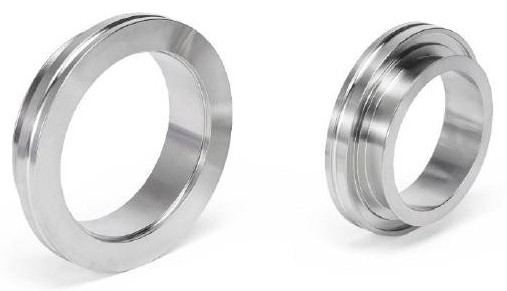
- CF — a copper gasket per joint, and the mating side is a CF weld flange of the same size and end style.
Full ranges: KF Vacuum Fittings, ISO Vacuum Fittings and CF Vacuum Fittings.
What to send with the enquiry
Send: connection system and size at both ends (or the flange ODs you measured) · free length · the motion to be absorbed (direction, static or cyclic, source) · medium, vacuum level and temperature in service · material requirement · O-ring or gasket material · quantity · cleaning, packing and documentation needs · a dimensioned sketch or photo if the line already exists.
The last item does most of the work. A photo of the existing gap with a scale, plus the flange OD at each end, resolves the majority of bellows enquiries without a round of questions.
Send your bellows requirements
Frequently asked questions
How do I know which bellows size to order?
Identify the connection system first, then size by the flange: flange outside diameter for KF, nominal bore plus flange OD for ISO-K, and the CF size for CF. Measure the flange you have instead of reading a label — KF10 and KF16 share the same 30 mm flange OD and are told apart by the bore.
What is “free length”?
The length of the assembly between the two flange faces at rest, with no movement applied. Catalog ranges run 100–2000 mm for KF and ISO-K and 100–1000 mm for CF, with other lengths quoted as custom items.
How much movement can a bellows take?
It depends on the bellows size, length and convolution design, and on the conditions it will see. State the direction, whether it is static or cyclic, and what causes it; the allowable values are confirmed for the ordered item rather than taken from a generic figure.
Can a bellows compensate for a badly aligned line?
Up to a point. It absorbs the small offsets, vibration and thermal movement a line normally has. If a bellows is being asked to close a large permanent offset, the line should be corrected rather than bridged.
Do I need to buy clamps and gaskets separately?
Yes. Each KF end needs a clamp, a centering ring and an O-ring; each ISO-K end a clamp with its centering ring and O-ring; each CF end a copper gasket. They are listed under compatible components.
Can I get a length that is not in the catalog, or different ends on each side?
Yes — custom lengths are quoted against the required free length, and mixed end combinations are handled as specified items. Send the two end sizes, the free length and the drawing if you have one.