
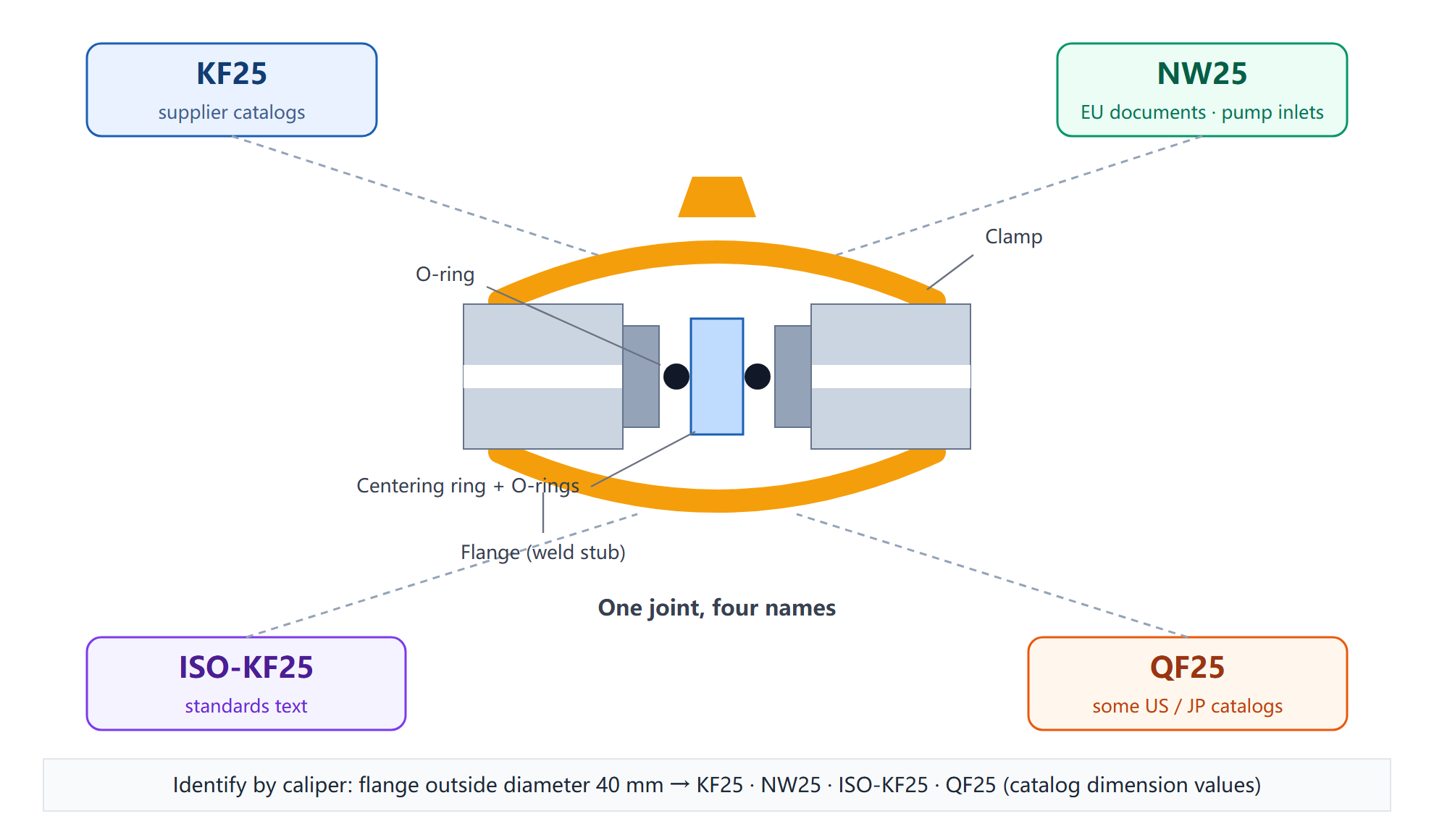
Quick answer. In everyday vacuum practice, KF, NW, QF and ISO-KF usually all point to the same thing: the small clamp-type flange with an elastomer O-ring in a centering ring, closed by a single clamp. They are four names for one joint system, met in different markets and different documents — not three competing standards. The practical risk is not the name; it is assuming that the number after the name is a dimension you can measure. A “KF25” flange does not measure 25 mm across its face — it measures 40 mm. Order by the flange outside diameter and the matching hardware, and the name stops mattering.
[HERO 3-UP]
Same joint, four names
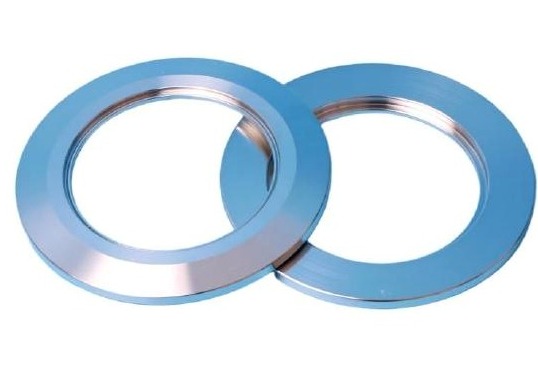
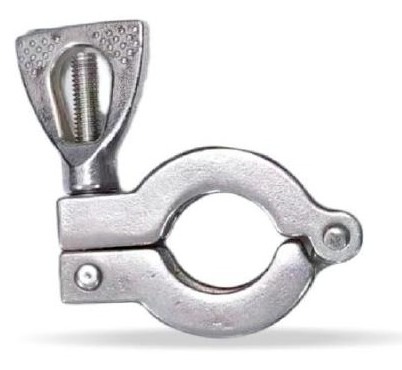
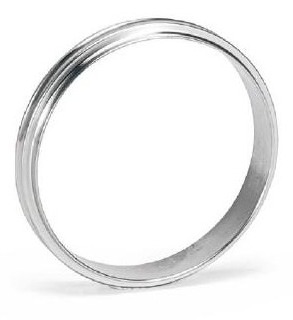
The joint itself is one system: two identical flanges, a centering ring that carries the O-ring, and a clamp that pulls the faces together. It is designed for fast, tool-light assembly and repeated opening — which is why this system dominates forelines, roughing lines and utility connections. The catalog covers KF10 to KF200, with quick-release fittings, clamps and valves concentrated in KF10, KF16, KF25, KF40 and KF50.
The four names, used interchangeably in the industry:
| Name | Where you meet it | What it refers to |
|---|---|---|
| KF | Most supplier catalogs, including ours | The clamp-type small flange system (from the German Kleinflansch, “small flange”) [IND] |
| NW | European documents, older drawings, pump inlets | The same joint, named by nominal bore (Nominalweite): NW25 = KF25 [IND] |
| ISO-KF | Standards text and international documentation | The same joint under the ISO designation for the small clamp flange [IND] |
| QF | Some US and Japanese supplier catalogs | The same joint, “quick flange”: QF40 = KF40 [IND] |
If a drawing, a pump inlet or a legacy part list says NW16, NW25 or QF25, the part you need is the KF-size component of the same number. What you should not assume is that the number itself is the size you measure with a caliper.
[NAME-MAP DIAGRAM]
The size chart that actually matters: flange outside diameter
The number in KF25, NW25 or QF25 is a nominal bore, not a flange dimension. The dimension that identifies the part — and that clamps and centering rings are matched to — is the flange outside diameter. Transcribed from the catalog tables:
| Nominal size | Flange outside diameter (mm) |
|---|---|
| KF10 | 30 |
| KF16 | 30 |
| KF25 | 40 |
| KF40 | 55 |
| KF50 | 75 |
| KF63 | 87 |
| KF80 | 114 |
| KF100 | 134 |
| KF160 | 190 |
| KF200 | 252 |
Values are transcribed from the catalog dimension tables for KF weld stubs, blanks and fittings, and are re-checked against the drawing before order confirmation. Measure the flange outside diameter first; the table turns it into the nominal size to quote. If you are replacing an existing part and cannot measure the flange, a photo together with the tube outside diameter is usually enough to identify it.
The KF10 / KF16 trap: same flange OD, different bore
One entry in the table deserves its own warning: KF10 and KF16 share the same 30 mm flange outside diameter. Measuring the flange alone cannot separate them. The difference is the bore — the KF10 joint carries a smaller bore than the KF16 joint for the same flange diameter.
So when you measure a 30 mm KF flange, confirm one more dimension — the tube outside diameter it is welded to, or the bore — before you order. This is the single most common mis-identification in this size range, and it is also why a photo of the part helps: the bore difference is visible even in a rough photograph.
A complete KF joint is four parts, not one
Ordering “a KF25” and receiving one flange does not make a joint. A working KF connection is:
- Two mating KF flanges — weld stubs, blanks or the ends of fittings and valves;
- A centering ring matched to the flange OD, which holds the O-ring centered so it is not drawn into the bore;
- An O-ring — FKM or NBR in our catalog, confirmed against the medium and conditions;
- A clamp matched to the same flange OD, in aluminum double-pin or stainless steel single/double-pin style.
The blank flange that terminates an unused port, the straight tube that bridges two components, and the bellows that absorbs misalignment all close with this same hardware. Send the complete list with the order, not just the flange.
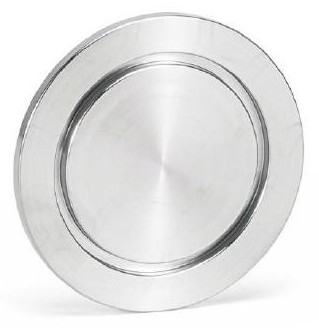
[BLANK PHOTO]
What to confirm when you order
- the nominal size (KF / NW / QF number) and the measured flange outside diameter;
- if the flange OD is 30 mm: whether the part is KF10 or KF16 — check the bore or tube OD;
- the part type: weld stub, blank, fitting end, or valve;
- the O-ring material for your medium (FKM or NBR as listed; final choice confirmed per application);
- the clamp style: aluminum double-pin, or stainless steel single/double-pin;
- quantity, and a drawing or photo if the part replaces something existing.
Frequently asked questions
Is NW the same as KF?
In common industry usage, yes — NW and KF refer to the same clamp-type small flange joint, with NW naming the joint by nominal bore. NW25 and KF25 denote the same connection. Because naming practice varies between suppliers and documents, confirm the joint by the flange outside diameter and the mating dimensions before ordering.
Is QF the same as KF?
Yes — QF (“quick flange”) is a naming convention used in some catalogs for the same clamp-type joint. QF25 corresponds to KF25. As with NW, treat the name as a pointer, not a specification: order by the measured flange OD and the matching hardware.
What size is a NW25 flange?
NW25 corresponds to KF25, whose flange outside diameter is 40 mm. The “25” is the nominal bore, not the flange dimension — a caliper reading of 40 mm across the flange face identifies the joint.
Why do KF10 and KF16 have the same flange diameter?
Both use a 30 mm flange outside diameter; they differ in the bore. This is why the flange OD alone cannot identify a 30 mm KF part — confirm the tube outside diameter or bore before ordering.
What parts do I need for one complete KF connection?
Two mating flanges, one centering ring, one O-ring and one clamp, all matched to the same flange OD. The O-ring is ordered separately from the centering ring.
Does the KF number work the same way for ISO-K and CF?
No. ISO-K/ISO-F joints are named ISO63, ISO80 and so on with their own dimension series, and CF flanges are referenced by nominal size with inch-based outside-diameter naming alongside. The compare-and-identify method in KF vs ISO vs CF Vacuum Flanges covers all three systems.
Next step: order the complete KF joint
Name the system in whatever shorthand your documents use — KF, NW, QF or ISO-KF — then send the measured flange OD and the parts list:
- KF Vacuum Fittings — weld stubs, blanks, tubes, elbows, tees, crosses, bellows and threaded adapters
- KF Vacuum Clamps — aluminum double-pin and stainless steel single/double-pin
- KF Centering Rings — standard and screened versions
- O-Rings and Support Rings — FKM and NBR
If the part connects two different systems, see How to Choose a Vacuum Flange Adapter. To send your measured dimensions for a quotation, contact us.