
Quick answer. A vacuum flange adapter is a single part that joins two different connection systems or two different sizes — KF to KF, KF to ISO-K, KF to CF, CF to ISO, CF to CF, or ISO to ISO. Choose it in four steps: name both ends exactly (system and size — never “ISO” alone), confirm the mating dimensions at both ends, order the sealing and closure hardware for each end separately, and check what the size or length change does to the line. An adapter resolves the mechanical connection only; it does not raise the vacuum, pressure or temperature rating of either end.
What an adapter does — and what it does not do
An adapter exists for one reason: to let a line be built from the system that suits each section. A KF-sized pump feeding an ISO-K trunk line, or a CF-sealed chamber port taking a KF instrument, needs a transition somewhere. The adapter is that transition.
Three limits are worth stating plainly:
- It resolves the mechanical joint only. The character of the assembly is governed by its weakest joint. An adapter with an elastomer-sealed end does not inherit the metal-seal character of the CF section it is bolted to.
- A change of bore or length changes the conductance of that section. Where line performance is critical, confirm the effect with the technical contact before ordering rather than assuming the adapter is neutral.
- It is a transition part. It connects two systems; it does not raise the capability of either side.
The adapter families in the catalogue
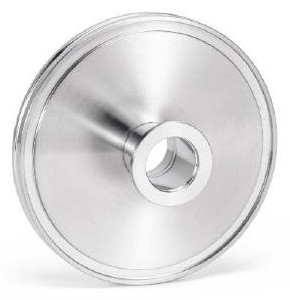
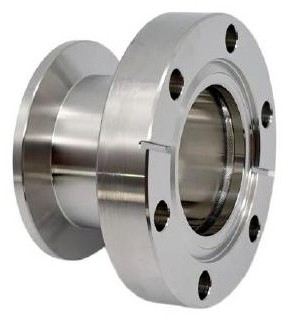
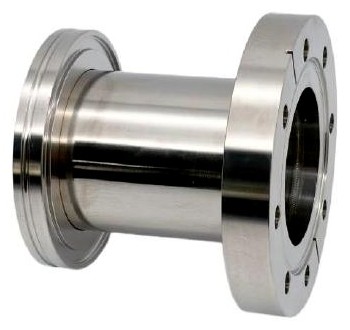
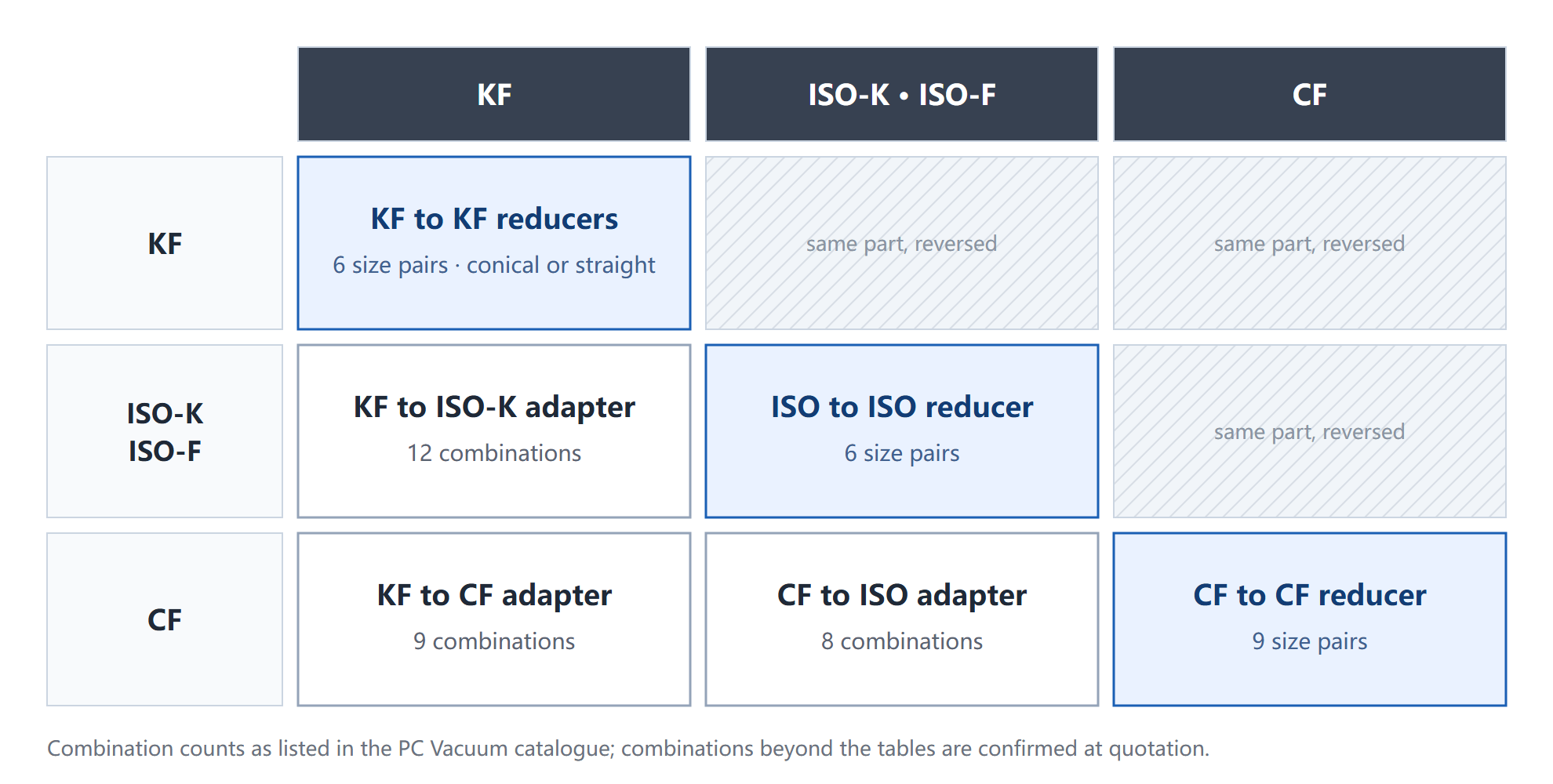
PC Vacuum catalogues six adapter families covering the combinations between KF, ISO-K/ISO-F and CF:
| Family | Connects | Catalogue coverage |
|---|---|---|
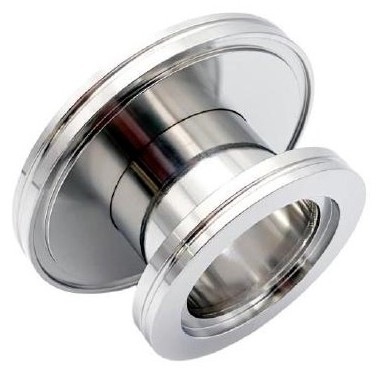
| KF reducers | KF to KF, in two forms: conical reducer and straight reducing pipe | Six size pairs, KF16-KF10 to KF50-KF40 |
| KF to ISO-K adapter | KF to ISO-K | Twelve combinations: ISO63/80/100/160 × KF25/40/50 |
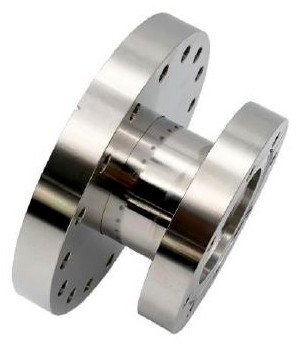
| KF to CF adapter | KF to CF | Nine combinations, CF16-KF16 to CF63-KF63 |
| CF to ISO adapter | CF to ISO-K | Eight combinations, ISO63-CF63 to ISO100-CF200 |
| CF to CF reducer | CF to CF | Nine size pairs, CF25-CF16 to CF250-CF200 |
| ISO to ISO reducer | ISO to ISO | Six size pairs, ISO80-ISO63 to ISO320-ISO250 |
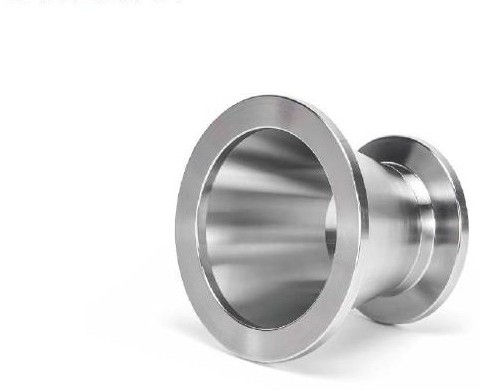
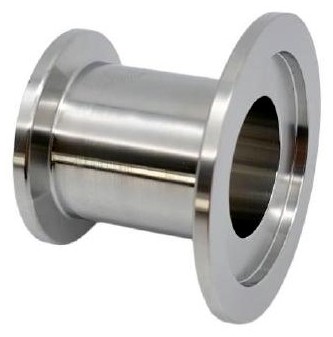
Each family has its own page with the full size tables and dimensions: KF reducers, KF to ISO-K adapter, KF to CF adapter, CF to ISO adapter, CF to CF reducer and ISO to ISO reducer. The tables on those pages are the authority for dimensions — not this article.
How to read an adapter size code
Adapter model codes name the two ends, separated by a hyphen:
KF50-KF40— a KF reducer, KF50 on the large end and KF40 on the small end.ISO63-KF40— ISO-K on one side, KF on the other.CF63-CF50— CF to CF, one size step down.
Two points follow from this:
- Read the code from the page, not from memory. Different suppliers order the two ends differently. Do not infer which end is which from the position in the code — open the size table and read the column definitions.
- A code is not a complete specification. The same code does not by itself carry the flange outside diameter, the tube outside diameter or the hole pattern. Those are separate columns and must be matched to the mating flanges.
Each end keeps its own sealing and closure system
An adapter joins two systems; it does not merge them. Each end keeps the sealing principle and the hardware of its own family:
| End | Seal | Closure | Hardware needed at that end |
|---|---|---|---|
| KF | Elastomer O-ring seated in a centring ring | Clamp over the two mating flanges | Centring ring with O-ring + KF clamp |
| ISO-K | Elastomer O-ring seated in a centring ring | Single-claw, double-claw or caliper clamps | Centring ring with O-ring + ISO-K clamps |
| ISO-F | Elastomer O-ring seated in a centring ring | Bolts through a loose ring | Centring ring with O-ring + bolt set |
| CF | Oxygen-free copper gasket, metal seal | Bolts, knife edge pressed into the gasket | Copper gasket + bolt set |
On a mixed adapter — for example CF to ISO-K — the CF side is metal-sealed and the ISO side is elastomer-sealed. The assembly is only as good as its weakest joint, so place a mixed joint where its elastomer end is acceptable for the medium and the process. The consumables (centring rings, O-rings, clamps, gaskets, bolts) are ordered per end and per size; the adapter body does not include them.
Five checks before you order
1. Name both systems exactly. KF, ISO-K, ISO-F or CF, at both ends. “ISO” alone leaves the closure and the flange face undefined: ISO-K closes with clamps, ISO-F with bolts through a loose ring, and the two are not interchangeable.
2. Confirm both sizes and the mating dimensions. The nominal size is not enough. Flange outside diameter, tube outside diameter and hole or thread pattern must be matched at both ends. For a CF end, send the mating flange drawing or its hole pattern — the catalogue lists the P.C.D and hole counts for the CF side of the KF to CF adapter per size, and other CF-side patterns are confirmed against the drawing at quotation.
3. Order the sealing and closure hardware for each end. This is the most common omission. A KF to CF adapter needs a copper gasket on the CF side and a centring ring, O-ring and clamp on the KF side — two different consumable sets.
4. Check length and installation space. A conversion flange is short by design; the length of the run comes from the tubes on either side. Confirm clamp swing room at a clamped end and tool room at a bolted end, especially inside an enclosure.
5. Check what the transition does to the line. A bore step changes conductance, and a length change adds or removes volume. Where the line’s performance matters, confirm the effect with the technical contact rather than assuming the adapter is transparent.
Planning a line that mixes KF, ISO and CF
Mixing the three systems in one line is normal. The pattern that avoids problems is to decide the system section by section and place the transitions deliberately:
- Trunk lines and large bores — ISO-K, stepped down with an ISO to ISO reducer where a branch leaves the main line.
- Quick-access points — KF, where a clamp and O-ring can be released and remade during setup and maintenance.
- Fixed, all-metal or long-closed joints — CF, where an elastomer at the sealing face is not acceptable.
- System boundaries — an adapter at each point where the system changes. Typical examples: a CF chamber port taking a KF instrument, or an ISO-K trunk line feeding a KF pump port.
Two practical points: leave room for the adapter and its closure hardware at each boundary, and confirm the assembly as a whole rather than part by part. A line is only as good as its weakest joint, and the adapter is usually where the two sealing principles meet.
Common ordering mistakes
Most adapter problems are specification problems rather than product problems:
- Writing “ISO” without K or F. The closure hardware and flange face differ; the part may not be usable with what you already have.
- Ordering by nominal size alone. “KF25” or “DN25” does not define the part. Flange outside diameter, tube outside diameter and hole pattern must also match.
- Ordering the adapter and forgetting the seals. Centring rings, O-rings, clamps, copper gaskets and bolts are ordered separately, per end and per size.
- Assuming an adapter upgrades the line. It makes two systems fit; it does not raise the vacuum, pressure or temperature capability of either end.
- Not sending the mating drawing for a CF end. CF bolt patterns are size-specific; the drawing removes the ambiguity.
- Treating the adapter as an adjustable spacer. Conversion-flange lengths are fixed values in the catalogue, for example the CF to CF reducer is listed at a constant length across all size pairs. Take the length from the table.
- Reusing a deformed copper gasket. A CF gasket is formed by the knife edges on assembly; treat it as a consumable and inspect the knife edges before remaking the joint.
Going through these seven points before an order usually prevents a round of clarification afterwards.
FAQ
Does an adapter change the vacuum, pressure or temperature rating of a line?
No. It resolves the mechanical connection only. The rating of the assembly is still governed by its weakest joint, and a change of bore or length affects the conductance of that section.
Can KF, ISO and CF be joined in any combination?
Between the three systems the catalogue covers KF to KF, KF to ISO-K, KF to CF, CF to ISO-K, CF to CF and ISO to ISO. Note the ISO side of the catalogue adapters is the ISO-K closure; ISO-F versions are confirmed at quotation.
What else do I need to order with an adapter?
The sealing and closure hardware for each end: centring ring and O-ring plus clamp on a KF end, centring ring and O-ring plus claw clamps on an ISO-K end, a copper gasket plus bolts on a CF end. The two ends normally need different sets.
How is an ISO-K to ISO-F transition handled?
The catalogue’s ISO adapters are listed with the ISO-K closure. If a line needs an ISO-F end, state it on the RFQ; the closure and flange face are confirmed at quotation.
Are other size pairs available beyond the catalogue tables?
The catalogue lists the pairs printed in each family’s table. Other combinations are confirmed at quotation rather than assumed.
What information do you need to quote an adapter?
Both connection systems, both nominal sizes, the mating dimensions at each end (or a drawing), the seal and closure hardware required per end, material, working conditions, length requirement if any, and quantity. See Request a Quote.
Next step: send your specification
If you already know the two systems you need to join, open the matching family page:
- Vacuum Flange Adapters — all six families in one place
- KF Vacuum Reducers — KF to KF, conical and straight, six size pairs
- KF to ISO-K Adapter — twelve combinations
- KF to CF Adapter — nine combinations
- CF to ISO Adapter — eight combinations
- CF to CF Reducer Adapter — nine size pairs
- ISO to ISO Reducer Adapter — six size pairs
If you are still deciding which system each section should use, start with KF vs ISO vs CF Vacuum Flanges and then send your drawing or BOM with the working conditions. Items that can be fixed are quoted directly; anything undecided is listed as open rather than assumed.