
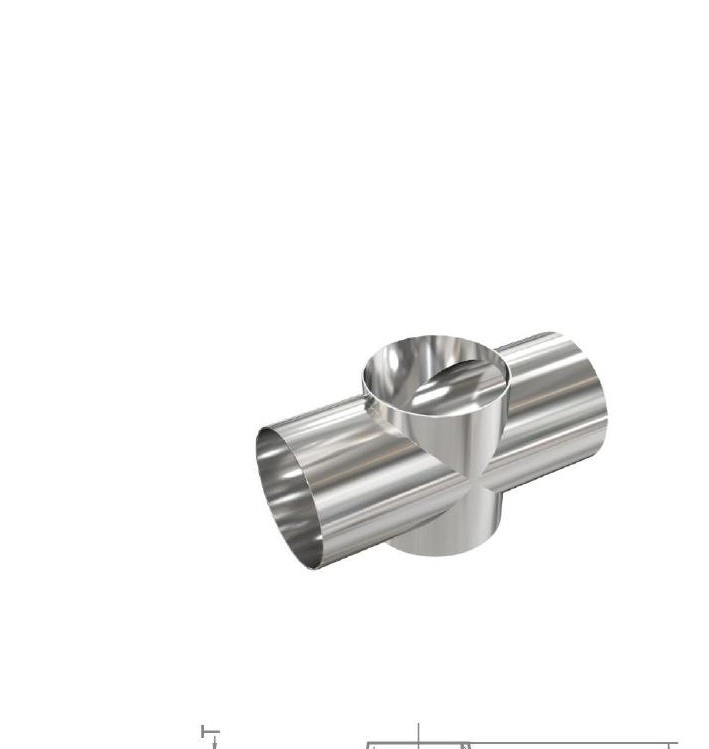
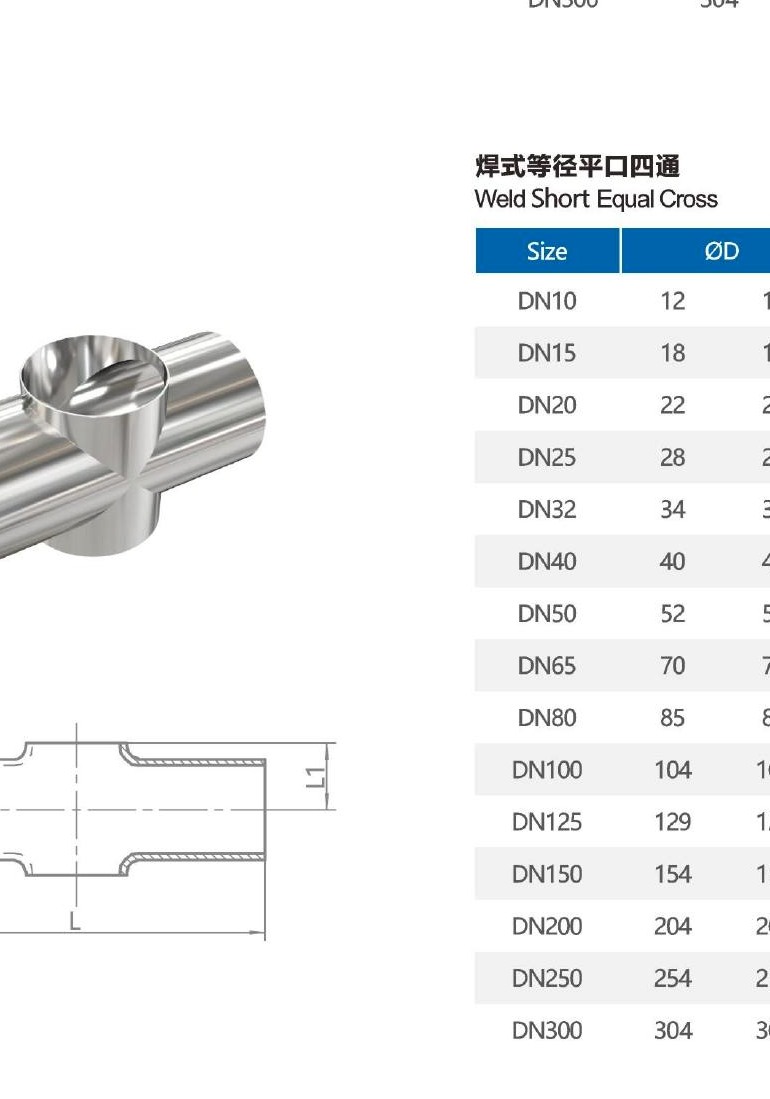
Product photo and dimensional drawing — click a thumbnail to switch.
DIN weld crosses pass two lines through one all-welded node in the DIN system: four equal ports, in a long pattern (PC-068) and a short, flat-end pattern (PC-069). The catalog covers DN10 to DN300 — the largest cross range in the sanitary line.
- Catalog sizes: DN10 – DN300 (15 steps)
- Stainless steel (grade confirmed at quotation)
- Custom sizes, materials and cleaning/packing handled through Custom Manufacturing
Why Source DIN Sanitary Weld Crosses from PC Vacuum
- ISO 9001 quality system. The company is certified to the ISO 9001 quality management system and holds independent R&D patents, as stated in the company catalog.
- Precision machining capacity. Dozens of machining centers cover 2-axis to 5-axis work, supporting both standard parts and prototype customization.
- Catalog-listed inspection processes. Spectral analysis, dimension and height measurement, surface-roughness measurement, concentricity checks, helium mass-spectrometer leak testing and ultrasonic cleaning are part of the company’s stated process flow.
- Traceable production management. ERP and MES systems support standardized, digitally traceable production from material entry to packing.
Key Features
Crevice-free weld joints
Sanitary weld fittings butt-weld to tube so the bore stays smooth and free of gaps that could hold product.
Multiple standards in one family
3A, DIN, ISO, SMS and BS/JIS formats are listed so the fittings match the standard your line already uses.
Elbows, tees, crosses and reducers
Direction changes, branches and size steps are all covered within the same weld format.
Surface finish focus
Surface finish is part of the sanitary specification; catalog values are listed per series and confirmed at quotation.
Material options
The catalog lists stainless steel for this series; the specific grade is confirmed at quotation.
Tube matching
Weld fittings and tubes are dimensioned to the same standards, so bore and wall line up at the joint.
Customization Options
Beyond the catalog sizes, DIN Sanitary Weld Crosses can be customized around your project requirements: non-standard dimensions, material selection, special cleaning and packing needs, and matching interface drawings. Send your drawing or working conditions, and the engineering team will confirm feasibility and applicability before quotation.
Discuss Your Custom Requirement
Production and Inspection
The company states in its catalog that production runs on dozens of CNC machining centers (2-axis to 5-axis) under an ISO 9001-certified quality management system, with ERP and MES supporting standardized, traceable workflows. Catalog-listed quality processes include spectral analysis of incoming material, dimension and height measurement, surface-roughness measurement, concentricity detection, helium mass-spectrometer leak testing, ultrasonic cleaning and protective packing before delivery. Applicable limits for your specific part are confirmed per working conditions during quotation.
Applications and Boundaries
Catalog context: crossing distribution lines in DIN-built sanitary systems, from DN10 lines up to DN300 trunk sizes. Cleanliness class, finish and welding details are confirmed per project.
Applicability to your vacuum level, temperature and media is confirmed per working conditions before quotation.
Options at a Glance
| Select | Options |
|---|---|
| Standard | DIN |
| Pattern | Long (PC-068) · Short / without straight end (PC-069) |
| Size | DN10 – DN300 (15 steps) |
| Material | Stainless steel (grade confirmed at quotation) |
Specification
Long equal cross
| Size | ØD (mm) | L (mm) | T (mm) |
|---|---|---|---|
| DN10 | 12 / 13 | 52 | 1.5 |
| DN15 | 18 / 19 | 70 | 1.5 |
| DN20 | 22 / 23 | 80 | 1.5 |
| DN25 | 28 / 29 | 100 | 1.5 |
| DN32 | 34 / 35 | 110 | 1.5 |
| DN40 | 40 / 41 | 120 | 1.5 |
| DN50 | 52 / 53 | 140 | 1.5 |
| DN65 | 70 | 160 | 2 |
| DN80 | 85 | 180 | 2 |
| DN100 | 104 | 200 | 2 |
| DN125 | 129 | 375 | 2 |
| DN150 | 154 | 450 | 2 |
| DN200 | 204 | 600 | 2 |
| DN250 | 254 | 750 | 2 |
| DN300 | 304 | 750 | 3 |
Short equal cross, without straight end
| Size | ØD (mm) | L (mm) | L1 (mm) | T (mm) |
|---|---|---|---|---|
| DN10 | 12 / 13 | 52 | 8 | 1.5 |
| DN15 | 18 / 19 | 70 | 11 | 1.5 |
| DN20 | 22 / 23 | 80 | 13 | 1.5 |
| DN25 | 28 / 29 | 100 | 16 | 1.5 |
| DN32 | 34 / 35 | 110 | 19 | 1.5 |
| DN40 | 40 / 41 | 120 | 22 | 1.5 |
| DN50 | 52 / 53 | 140 | 28 | 1.5 |
| DN65 | 70 | 160 | 37 | 2 |
| DN80 | 85 | 180 | 44.5 | 2 |
| DN100 | 104 | 200 | 54 | 2 |
| DN125 | 129 | 375 | 66.5 | 2 |
| DN150 | 154 | 450 | 79 | 2 |
| DN200 | 204 | 600 | 104 | 2 |
| DN250 | 254 | 750 | 129 | 2 |
| DN300 | 304 | 750 | 155 | 3 |
— transcribed from the catalog tables; re-checked against the drawings before order confirmation.
Values are transcribed from the catalog tables and re-checked against the drawings before order confirmation.
How to Select
- Confirm the DIN standard for the line.
- Long pattern for standard runs; the short flat-end version butts directly to tube.
- ØD column: two values per DN up to DN50 — match the tube ordered.
- Surface finish, weld procedure and material grade are confirmed at quotation.
Compatible Components
DIN Sanitary Reducing Tees · DIN Sanitary Weld Tees · DIN 11850 Sanitary Tube · Sanitary Fittings (all standards)
How the Sanitary Weld Joint Works
A sanitary weld joint joins the fitting and the tube with a butt weld around the matched bore. The aim is a smooth, continuous inner surface: correct fit-up gap, qualified welding parameters and a controlled internal bead, per your process specification. Because the joint is permanent, the layout is planned so that sections that need frequent service use clamped or sanitary clamp connections instead.
Installation Notes
- Fit-up: match bore and wall between fitting and tube; confirm alignment before tacking.
- Welding: weld per your qualified sanitary welding procedure; keep the internal bead smooth and free of crevices.
- Cleaning: clean and passivate the weld area per your process requirements before the line enters service.
- Verification: inspect the weld and evaluate the line as part of your standard hygiene and leak-check procedure.
For system-specific welding and leak-test requirements, confirm with your process specification; our engineers can advise during quotation.
Frequently Asked Questions
DN250/DN300 lengths are the same (750)?
Yes — both steps carry L = 750 mm in the catalog table.
Is the cross equal-diameter only?
Yes — all four ports share the size; reducing nodes are built from reducing tees.
RFQ Checklist
Send: standard (DIN) · pattern (long/short) · size(s) · tube OD · material grade · surface finish and welding requirements · medium and cleanliness requirements · quantity · drawings.
Customer Reviews
“We ordered parts for our test-stand vacuum lines. Dimension checks on arrival matched the catalog drawings, and assembly on site was straightforward.”
— T., Equipment Engineer
“Communication was clear through the RFQ stage: they asked for our dimensions and working conditions before quoting, and the parts matched what we agreed.”
— S., Procurement
“Consistent machining quality between batches. We use these parts on maintenance loops where the joints are opened regularly, and the sealing surfaces have held up well.”
— M., Maintenance Lead
Reviews shown are sample summaries pending verified customer feedback.
Certifications
ISO 9001 Quality Management System
Science & Technology SME Certificate
Patents & Design Certificates
Certificates as displayed in the company catalog; certificate documents are available on request.