
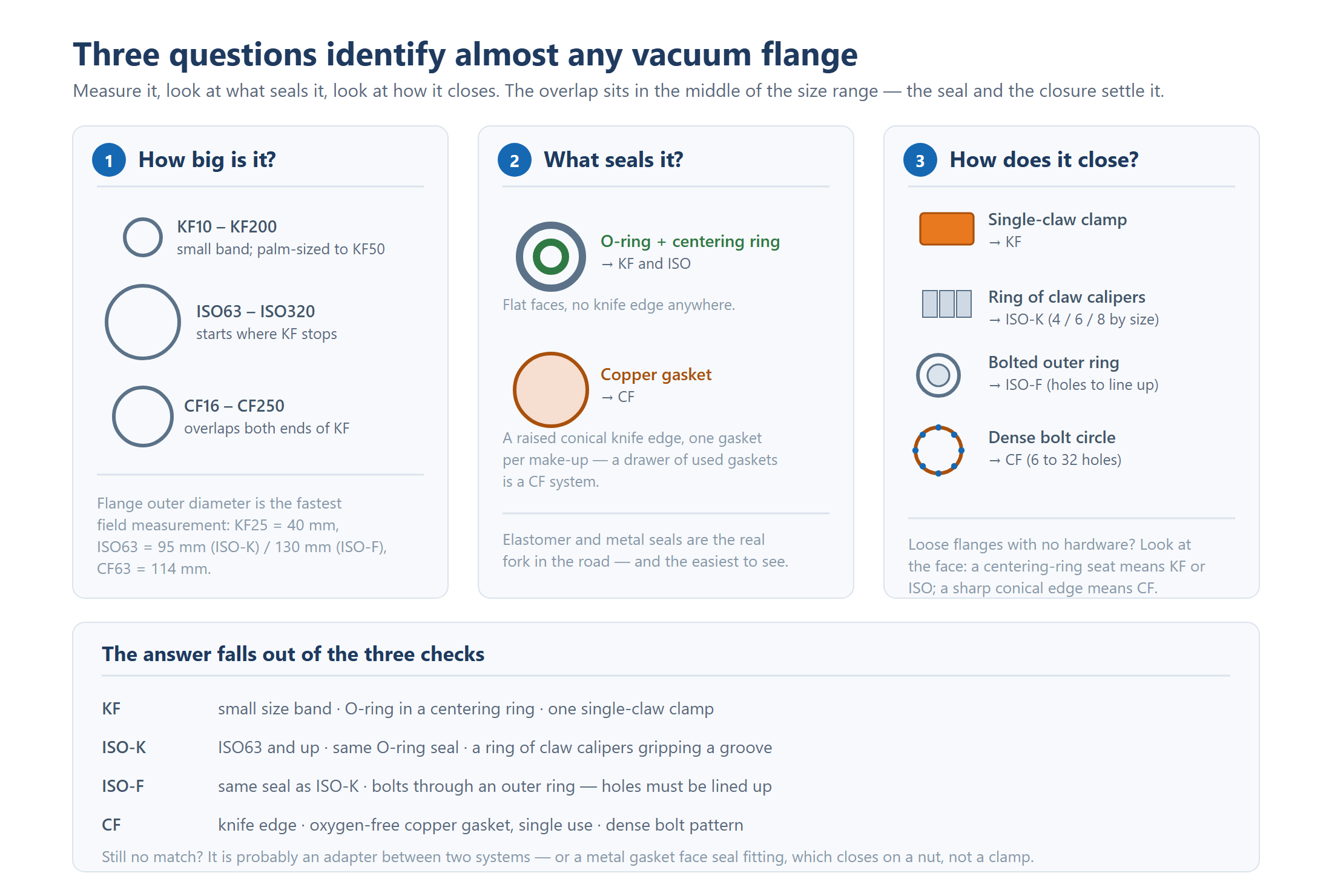
Quick answer. Three questions identify almost any vacuum flange you pick up. How big is it? KF tops out at the small end of the range, ISO starts where KF stops, and CF overlaps both. What seals it? If a rubber O-ring sits in a centering ring, it is KF or ISO. If a copper ring with a knife-edge impression is involved, it is CF. How is it closed? A single-claw clamp is KF, claw calipers are ISO-K, a bolted ring that turns is ISO-F, and a dense bolt circle around a cone-shaped face is CF. Get those three answers and you rarely need a drawing.
Question 1: how big is it?
Size does most of the work, because the three systems were designed for different bands. The catalog ranges are:
| System | Catalog range | Typical working sizes |
|---|---|---|
| KF | KF10 – KF200 | KF10, KF16, KF25, KF40, KF50 |
| ISO-K / ISO-F | ISO63 – ISO320 (ISO-K flange range extends to ISO500) | ISO63, ISO100, ISO160, ISO200 |
| CF | CF16 – CF250 | CF16, CF35, CF63, CF100, CF150 |
So a flange that fits in your palm is almost certainly KF, and anything with a bore above 63 mm is ISO or CF rather than KF. The overlap sits in the middle: CF16 to CF50 sit in the same size band as large KF, which is exactly where mis-identification happens.
Flange outer diameter is the fastest field check, because it is a number you can measure with a rule:
| Nominal | Outer diameter | |
|---|---|---|
| KF25 | 40 mm | KF range |
| KF40 | 55 mm | KF range |
| KF50 | 75 mm | KF range |
| ISO63 | 95 mm | ISO-K |
| ISO63 | 130 mm | ISO-F (the bolted ring adds material) |
| CF63 | 114 mm | CF |
Values are per catalogue row. Compare against the table for the exact size rather than assuming a pattern — the flange diameter grows with the bolt circle, not with the bore alone.
Question 2: what seals it?
This is the question that settles the biggest fork in the road, because it splits the systems into two sealing families:
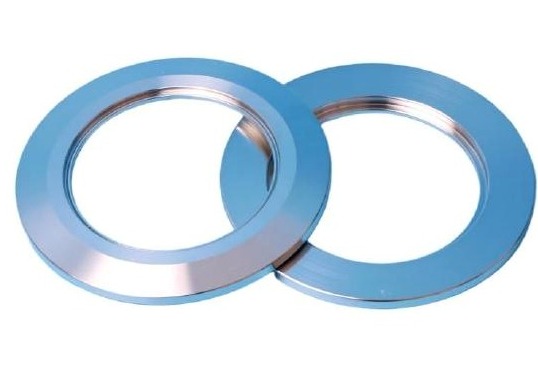
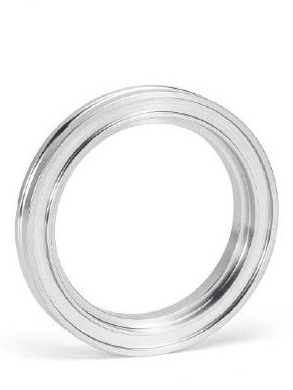
- Elastomer seal — KF and ISO. A centering ring holds a rubber O-ring between the two flange faces. There is no knife edge anywhere: both faces are flat, and the centering ring does the locating. If you can see a groove for an O-ring, or find a centering ring in the box, you are in the KF or ISO family.
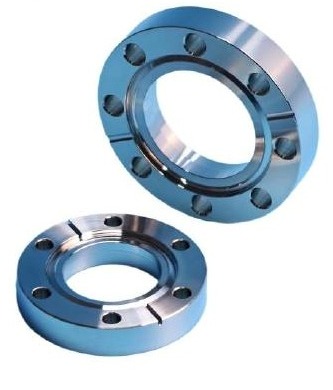
- Metal seal — CF. The seal is an oxygen-free copper gasket compressed between two knife edges. The flange face is not flat: it carries a raised conical edge, and the gasket arrives with a matching profile. If there is a copper ring, or a flange face with a sharp circular edge, it is CF.
Two tells separate them at a glance. A CF flange almost never arrives without a gasket order, because the copper gasket is single-use and replaced at every make-up — a bag of used gaskets in a drawer is a CF system. And a KF or ISO flange will have a shoulder or recess for the centering ring, which a CF flange does not.
Question 3: how is it closed?
The closing hardware is the third identifier, and it also distinguishes ISO-K from ISO-F, which use the same seal:
| Closure | System | What you see |
|---|---|---|
| Single-claw clamp | KF | One hinged claw with a wing nut or bolt, snapping over the flange pair. One piece closes the joint. |
| Claw caliper clamps | ISO-K | Several calipers around the circumference — four, six or eight depending on size — each gripping the flange groove. |
| Bolted outer ring | ISO-F | A ring with a bolt hole pattern that sits on the stub. If you have to line up bolt holes, it is ISO-F, not ISO-K. |
| Bolts through a dense pattern | CF | A circle of clearance holes close to a conical face, closed with bolts (and often nuts, or a tapped mating flange). CF250 carries 32 holes. |
The KF clamp count is the giveaway for size: the small sizes close with a single clamp, while ISO-K needs a ring of them, and the count steps up with diameter. For ISO, the catalog recommends four clamps at ISO63–ISO100, six from ISO100–ISO200, and eight above ISO250 — see the ISO clamp range and the size-by-size comparison in ISO-K vs ISO-F.
The face is the last check
If the hardware has been separated from the flanges — a box of loose flanges with no clamps — look at the face:
| What you see | What it is |
|---|---|
| Flat face with a machined groove or seat for a centering ring | KF or ISO-K (sealing by O-ring) |
| Flat face with a bolt circle and a smooth stub bore | ISO-F outer ring or a rotatable flange |
| A raised circular edge with a sharp profile, bolt holes close in | CF, closed over a copper gasket |
| A flat face with a bolt circle and an internal bore, no groove | Likely a blank or blind flange — check the mating part |
On CF specifically, the hole pattern is a strong tell: the holes sit close to the knife edge and the count is high — 6 holes at CF16, 8 at CF50–CF63, 16 at CF80–CF100 and 32 at CF250. A flange with that many closely spaced bolt holes is not KF or ISO. The full pattern table, and how tapped and through holes change the assembly, are in Rotatable vs Fixed CF Flanges.
What is often mistaken for one of these three
- Small metal-seal fittings. A face seal fitting with glands, nuts and a metal gasket looks like a small vacuum joint but is not a flange system at all — it closes on a nut, not a clamp or bolt circle. See metal gasket face seal fittings for how that family identifies.
- Sanitary clamps. Tri-clamp style fittings share the “clamp over two faces” look with KF, but the seal is a flat gasket on a wide face and the sizes follow hygienic standards, not KF sizes.
- Threaded adapters. A threaded end is not a flange; where a threaded port has to meet a flange, the closure is an adapter — see flange adapters.
- ISO-F mistaken for ISO-K. The two share the seal and the size; only the closure differs. If the joint needs a bolt hole pattern lined up, it is ISO-F.
The three-question summary
| KF | ISO-K | ISO-F | CF | |
|---|---|---|---|---|
| Size band | KF10 – KF200 | ISO63 – ISO320 | ISO63 – ISO320 | CF16 – CF250 |
| Seal | Centering ring + O-ring | Centering ring + O-ring | Centering ring + O-ring | Oxygen-free copper gasket |
| Sealing face | Flat + seat | Flat + seat | Flat + seat | Knife edge |
| Closure | Single-claw clamp | Claw calipers (4/6/8) | Bolted outer ring | Bolts through dense pattern |
| Field tell | Small, one clamp | Large, ring of clamps | Bolt holes to line up | Copper ring, sharp edge, many holes |
If your answer still does not fit, the component is probably an adapter between two systems — the KF vs ISO vs CF comparison covers how the three connect and where adapters sit in the line.
Send us a photo and the measurement
For a positive identification, the three things we need are the bore or flange outer diameter, a photo of the sealing face, and a photo of the closing hardware. With those, the system and the size follow from the catalog tables above.
Frequently asked questions
How do I tell KF from ISO-K quickly?
Size and clamp type. KF is the small band with a single-claw clamp; ISO-K starts at ISO63 and closes with a ring of claw calipers. If both are on the bench, the KF flange is the one that fits in the palm.
How do I tell ISO-K from ISO-F?
Both use the same centering ring and O-ring. ISO-K closes with claw calipers that grip a groove; ISO-F closes with bolts through an outer ring that rotates on the stub. Lining up bolt holes means ISO-F.
How do I know a flange is CF?
A flat face is not CF. Look for a raised conical knife edge and a bolt pattern that sits close to it, and for a copper gasket in the joint. CF sizes run CF16 to CF250 with 6 to 32 bolt holes.
Can I identify a flange by its outer diameter alone?
It is a good first filter but not conclusive, because systems overlap in the middle of the range and ISO-K and ISO-F differ in diameter at the same nominal size. Use the diameter to narrow the system, then confirm with the sealing element and the closure.
What if there is no clamp or bolt ring — just loose flanges?
Look at the face: a groove or seat for a centering ring means KF or ISO, a sharp conical edge means CF, and a plain bolt circle with a smooth bore points to a blank or rotatable flange.
Is a tri-clamp fitting a KF flange?
No. Both clamp two faces together, but the sanitary fitting uses a wide flat gasket to hygienic standards and is not interchangeable with KF sizes or hardware.
What do you need from me to confirm it?
The bore or flange outer diameter, a photo of the sealing face and a photo of the closing hardware. Those three resolve system and size in almost every case.