
Quick answer. Fixed and rotatable CF flanges seal exactly the same way — a knife edge cuts into an oxygen-free copper gasket, and the joint is bolted through a hole pattern that is identical for a given size. What differs is whether the holes belong to the tube or to a ring that turns on it. A fixed flange has the drilled pattern in its own body, so the holes are locked to the tube orientation the moment it is welded. A rotatable (looper) flange is a weld stub plus a separate bolted ring: the ring spins on the stub, so the holes can be lined up after welding. On a bench that difference is invisible; in a chamber full of ports that have to align, it decides whether the joint goes together or the tube gets cut off and re-welded.
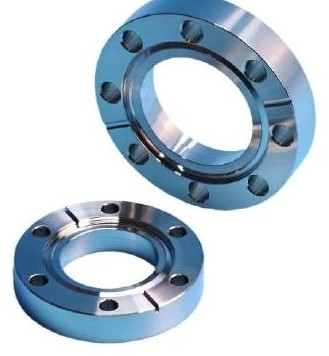
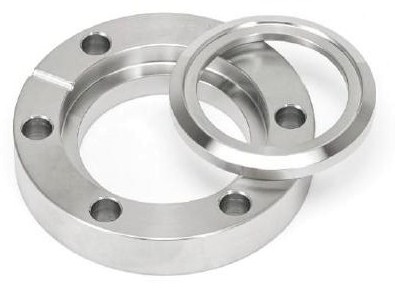
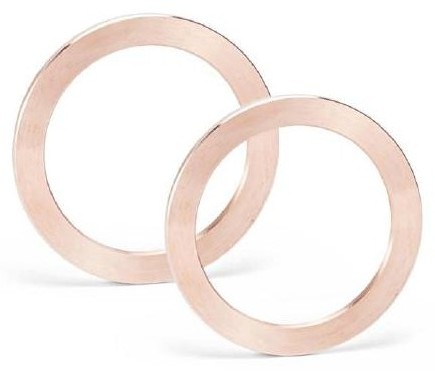
The joint is the same — only the bolt path changes
Both styles carry the same knife edge and the same counterbore for the gasket, so a CF50 fixed flange and a CF50 rotatable flange close against the same gasket with the same sealing result. Read the catalog tables side by side: the outer diameter ∅A and the bolt circle P.C.D are the same row for row, and the hole pattern is the same.
| CF size | ∅A (mm) | P.C.D (mm) | Hole pattern |
|---|---|---|---|
| CF16 | 34 | 27 | 6-Φ4.3 |
| CF25 | 54 | 43 | 6-Φ6.5 |
| CF35 | 70 | 58.7 | 6-Φ6.5 |
| CF50 | 86 | 72.4 | 8-Φ8.4 |
| CF63 | 114 | 92.2 | 8-Φ8.4 |
| CF80 | 130 | 110 | 16-Φ8.4 |
| CF100 | 152 | 130.3 | 16-Φ8.4 |
| CF150 | 202 | 181 | 20-Φ8.4 |
| CF200 | 253 | 231.8 | 24-Φ8.4 |
| CF250 | 305 | 284 | 32-Φ8.4 |
Two things to read out of that table. First, the hole count steps up with size — 6 holes at CF16, 8 from CF50 to CF63, then 16 from CF80, and up to 32 at CF250. A wider gasket needs more bolts to hold the closing load evenly around the circle, which is why the count roughly doubles at the larger sizes rather than creeping up one at a time. Second, the clearance diameter grows with the bolt size (Φ4.3, Φ6.5, Φ8.4), so the pattern is not interchangeable between sizes.
Every value here is quoted per row from the catalog table. Do not scale one size to another: a CF100 pattern is not “CF80 plus more holes” — the P.C.D and clearance diameter move together.
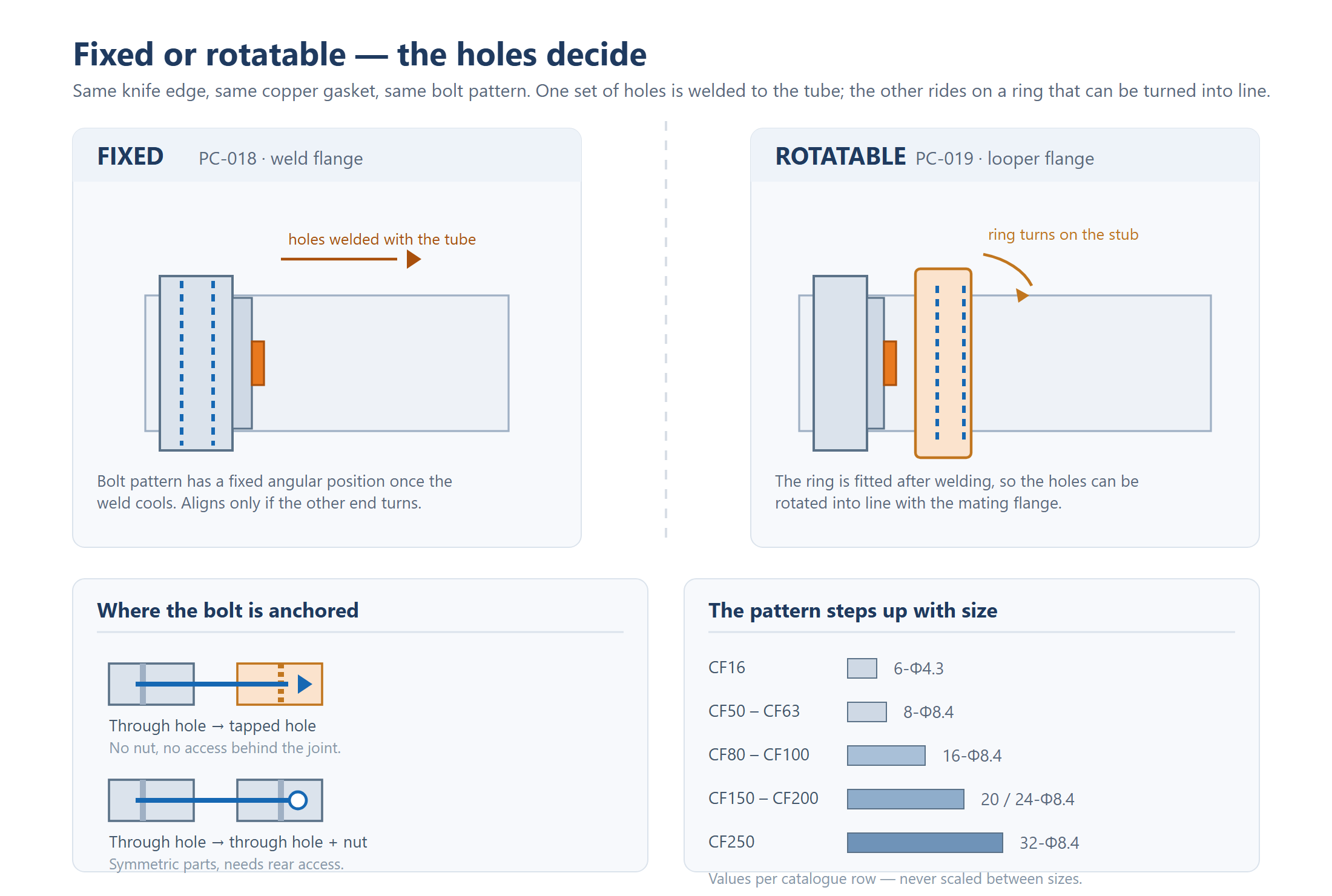
Fixed: the holes are welded in place
A fixed weld flange is welded to the tube or vessel wall with the tube sitting in the bore. Once the weld cools, the hole pattern has a permanent angular position relative to the tube. That is fine when the mating flange can be rotated into line — which is exactly why the two styles are normally used as a pair: rotatable on the branch, fixed on the matching port or fitting, so one side can always be turned to meet the other.
If both ends of a spool are welded fixed, the only way to align the holes is to rotate the whole tube — and if that tube is a welded assembly with a gauge port or a valve bolted to it, there is nothing left to turn. This is the single most common reason a CF sub-assembly has to be cut apart, and it is decided at the drawing stage, not at the bench.
Rotatable: the ring turns on the stub
The rotatable flange is two parts: a weld stub that goes onto the tube, and an outer ring carrying the bolt holes. The stub is welded first, and the ring is fitted after — so the hole positions can be set freely by rotating the ring, then locked in by the gasket and bolts at assembly.
The cost is one extra interface between stub and ring, and a taller assembly. Compare the two catalog tables and the difference shows in the bore and thickness columns rather than in the outer diameter: at CF50 the fixed flange has a 47.5 mm bore, while the rotatable pattern’s stub is closer to the nominal 50 mm, and the ring adds height (H column) that a fixed flange does not have. Where vertical space above the port is tight, that extra height is a real constraint.
Tapped holes and through holes
Bolt tension is what crushes the knife edge into the gasket, and the bolt has to be anchored at the far end. There are two ways to do that, and CF joints use both:
- Through hole to a tapped flange. The bolt passes through the clearance hole on one flange and threads into a tapped hole on the other. No nut is needed, and no hand has to reach behind the joint — this is what makes CF work in dense port layouts and inside frames.
- Through hole to through hole, with a nut. Both flanges carry clearance holes and the bolt is closed with a nut and washer at the back. It costs access space behind the flange, but the hardware is simpler and the flanges are symmetric.
The catalog tables give the clearance diameter per size (the ΦF column above). Whether the mating flange is tapped or drilled through is a joint-level decision confirmed at order — the two parts have to match, and a tapped flange bolted to another tapped flange will not close at all.
A practical note on mixing: a tapped flange and a through-hole flange of the same size and pattern close correctly; a tapped flange against a blind flange with a plain-hole pattern does not, because there is nothing to thread into. State the hole type per end when the assembly has more than one bolted CF joint, or an entire spool can arrive unbuildable.
What the gasket does to all of this
The gasket is the same part in both cases: an oxygen-free copper gasket of the matching CF size, and it is replaced at every re-make, because the knife edge leaves its impression. That has a layout consequence that people miss — a CF joint is not a joint you can break and re-close to check alignment. Every time you open it, a new gasket goes in. Alignment errors therefore have to be solved with rotatable flanges and correct hole types, not with repeated test assemblies.
For the knife edge itself and the tightening sequence, the CF flange assembly guide covers the tightening order and the damage modes; this article is about which flange style and hole type to put on the drawing.
Selecting fixed or rotatable, end by end
| Situation | Fixed | Rotatable |
|---|---|---|
| Port on a chamber wall, mating part can be turned | ✔ | ✔ |
| Branch tube in a rigid welded assembly | — | ✔ |
| Alignment must be set after welding | — | ✔ |
| Minimum height above the port | ✔ | — |
| Symmetric, repeated joints of the same size | ✔ | ✔ |
| Components such as blanks and gauges, turned by hand at assembly | ✔ | ✔ |
The rule that survives contact with real assemblies: at least one end of a bolted CF joint should be rotatable, or the joint should be a flange pair you can turn as a unit. A blank flange, a gauge flange or a valve is often the rotatable end in practice, because it can be held and turned during assembly.
Blind flanges and other ends
Terminating a port that is not used takes a CF blank flange — a solid disc with the same pattern and knife edge, closed over a fresh gasket. The same hole-type question applies: a blank with clearance holes is closed with nuts, a blank with a tapped pattern is closed with bolts directly. Where the line changes system, the closure is a flange adapter instead, and the CF end of that adapter follows the same rules as any other CF joint. The three connecting systems themselves — and how they are told apart — are compared in KF vs ISO vs CF Vacuum Flanges.
What to send with the enquiry
| # | Item |
|---|---|
| 1 | CF size per joint (CF16 – CF250) |
| 2 | Fixed or rotatable, per end |
| 3 | Hole type per end: clearance (through) or tapped |
| 4 | Thread system (metric per the catalog tables; inch patterns confirmed at quotation) |
| 5 | Gasket quantity — one per joint, replaced at each make-up |
| 6 | Working conditions: medium, vacuum level, temperature, bake requirement |
| 7 | Quantity and drawings, especially where the assembly is welded |
Items 2 and 3 are the ones that change the part; item 7 is the one that prevents a cut-and-re-weld later.
Frequently asked questions
Do fixed and rotatable CF flanges seal differently?
No. Both carry the same knife edge and gasket counterbore, and the joint closes over the same oxygen-free copper gasket. The difference is only in whether the bolt holes can be rotated after welding.
Is the bolt pattern the same for both styles?
Yes, size for size. In the catalog tables the outer diameter, P.C.D and hole pattern are identical for the fixed and rotatable versions of a given size. The rotatable version differs in the stub bore and the added ring height.
When should I choose a rotatable flange?
Wherever hole alignment cannot be guaranteed by rotating the mating part — typically the branch side of a rigid welded assembly. In most systems at least one end of a bolted CF joint is rotatable.
What is the difference between tapped and through holes on a CF flange?
With a tapped hole, the bolt threads directly into the flange and needs no nut or rear access. With through holes on both flanges, the joint is closed with nuts, which requires access behind the flange. The two ends of a joint have to match.
Can I reuse the copper gasket if the joint looks fine?
The knife edge impresses the gasket at every make-up, so the gasket is replaced each time the joint is closed. Plan for one gasket per joint per assembly.
How many holes does a CF250 flange have?
The catalog pattern runs from 6-Φ4.3 at CF16 to 32-Φ8.4 at CF250, with the count and clearance diameter both stepping up with size. Always read the value for the exact size.
Are inch-thread hole patterns available?
The catalog tables list the metric patterns; inch thread versions are confirmed at quotation.