
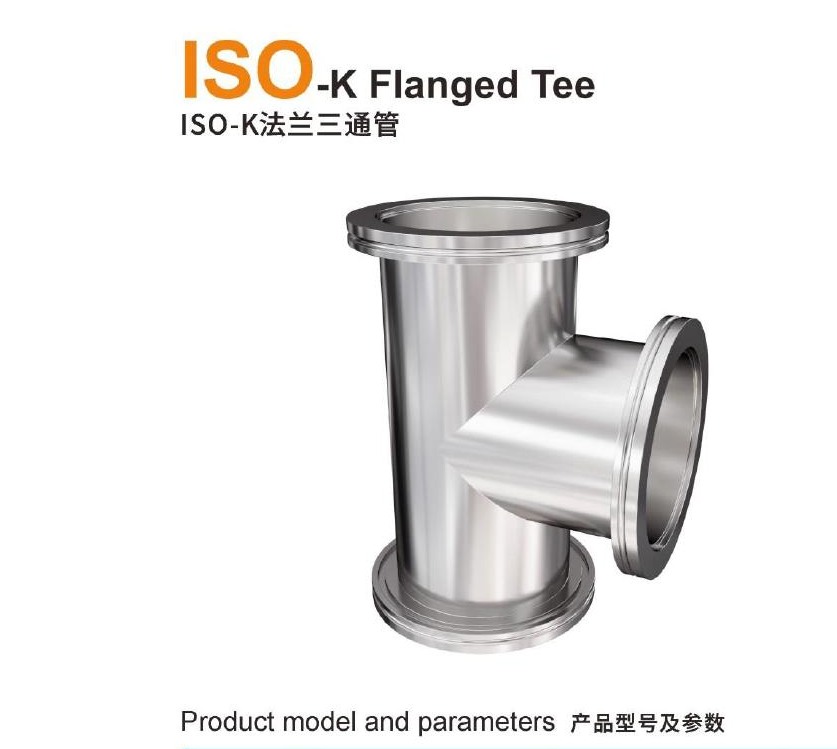
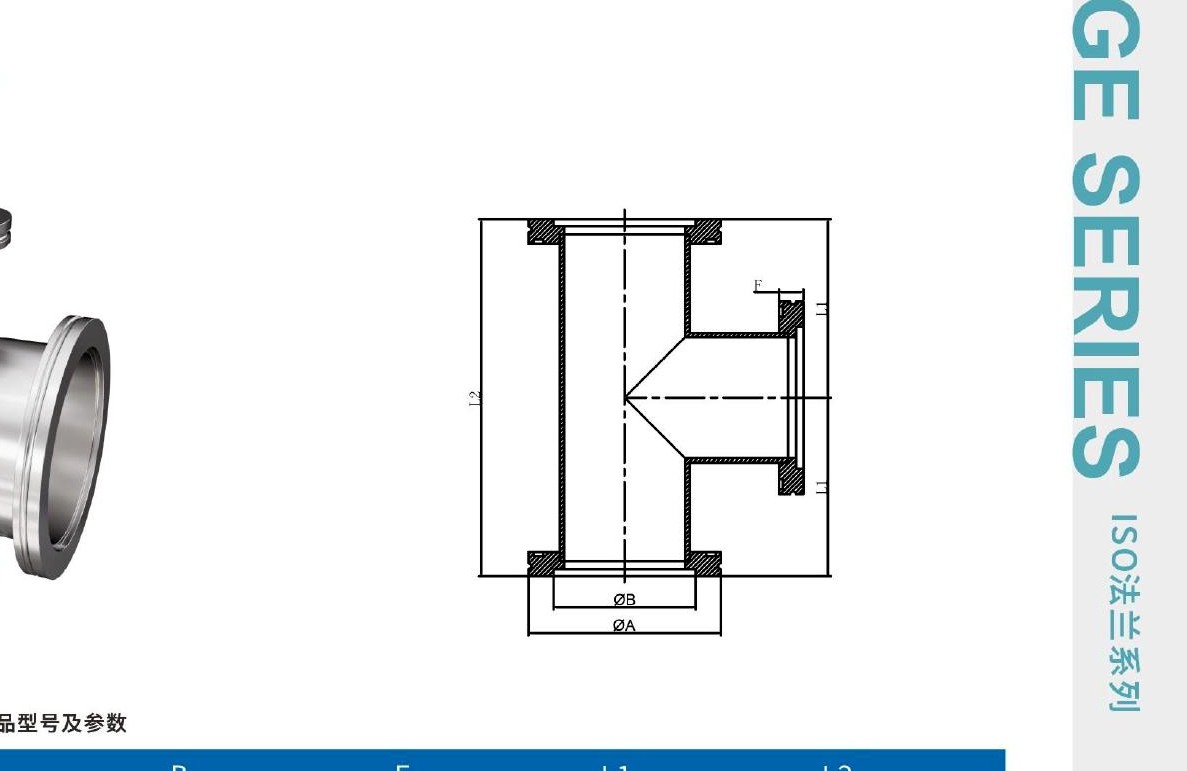
Product photo and dimensional drawing — click a thumbnail to switch.
The ISO-K flanged tee branches a large-bore clamped line: three ends, all ISO-K to the standard table, with L1 along the run and L2 across the branch. All three joints close with the same sealing sets and claw clamps as the rest of the system. The catalog covers ISO63 to ISO250.
- Catalog sizes: ISO63 · ISO80 · ISO100 · ISO160 · ISO200 · ISO250
- Stainless steel (grade confirmed at quotation)
- Custom sizes, materials and cleaning/packing handled through Custom Manufacturing
Why Source ISO-K Tee from PC Vacuum
- ISO 9001 quality system. The company is certified to the ISO 9001 quality management system and holds independent R&D patents, as stated in the company catalog.
- Precision machining capacity. Dozens of machining centers cover 2-axis to 5-axis work, supporting both standard parts and prototype customization.
- Catalog-listed inspection processes. Spectral analysis, dimension and height measurement, surface-roughness measurement, concentricity checks, helium mass-spectrometer leak testing and ultrasonic cleaning are part of the company’s stated process flow.
- Traceable production management. ERP and MES systems support standardized, digitally traceable production from material entry to packing.
Size Range
ISO63 – ISO80
Compact sizes for laboratory and pilot vacuum lines, pump connections and maintenance loops. Sizes covered: ISO63 · ISO80.
ISO100 – ISO160
Mid-range sizes for manifold branches, chamber ports and distribution lines between pumps and vessels. Sizes covered: ISO100 · ISO160.
ISO200 – ISO250
Large sizes for chamber outlets and high-flow sections; confirm mating interfaces against the drawing before ordering. Sizes covered: ISO200 · ISO250.
Key Features
Large-bore clamped system
ISO-K closes with claw clamps, so large-diameter joints can be opened quickly without removing many bolts.
Internal-weld and rotatable styles
Weld flanges carry the weld inside the bore; ISO-F rotatable flanges add a bolted outer ring where orientation matters.
Centering ring seal
A centering ring holds the O-ring centered between the faces, so the seal is positioned correctly every time the joint is closed.
Wide size coverage
The catalog runs from small pilot lines to large chamber ports within the same hardware family.
Material options
The catalog lists stainless steel for this series; the specific grade is confirmed at quotation.
System compatibility
Combines with ISO clamps, centering rings, blank flanges, fittings and ISO–KF/CF adapters.
Customization Options
Beyond the catalog sizes, ISO-K Tee can be customized around your project requirements: non-standard dimensions, material selection, special cleaning and packing needs, and matching interface drawings. Send your drawing or working conditions, and the engineering team will confirm feasibility and applicability before quotation.
Discuss Your Custom Requirement
Production and Inspection
The company states in its catalog that production runs on dozens of CNC machining centers (2-axis to 5-axis) under an ISO 9001-certified quality management system, with ERP and MES supporting standardized, traceable workflows. Catalog-listed quality processes include spectral analysis of incoming material, dimension and height measurement, surface-roughness measurement, concentricity detection, helium mass-spectrometer leak testing, ultrasonic cleaning and protective packing before delivery. Applicable limits for your specific part are confirmed per working conditions during quotation.
Applications and Boundaries
Catalog context: distribution points between pumps, valves and chambers in the ISO-K system. For gauge and instrument taps, the branch port takes an adapter down to the instrument flange.
Applicability to your vacuum level, temperature and media is confirmed per working conditions before quotation.
Options at a Glance
| Select | Options |
|---|---|
| Size | ISO63 · ISO80 · ISO100 · ISO160 · ISO200 · ISO250 |
| Configuration | Equal-diameter tee (all three ends same size) |
| Material | Stainless steel (grade confirmed at quotation) |
Specification
| Model | ∅A (mm) | ∅B (mm) | F (mm) | L1 (mm) | L2 (mm) |
|---|---|---|---|---|---|
| ISO63 | 95 | 70 | 12 | 88 | 176 |
| ISO80 | 110 | 83 | 12 | 108 | 216 |
| ISO100 | 130 | 102 | 12 | 108 | 216 |
| ISO160 | 180 | 153 | 12 | 138 | 276 |
| ISO200 | 240 | 213 | 12 | 178 | 356 |
| ISO250 | 290 | 261 | 12 | 208 | 416 |
— transcribed from the catalog table; re-checked against the drawing before order confirmation.
Values are transcribed from the catalog tables and re-checked against the drawings before order confirmation.
How to Select
- Size by nominal bore; the tee is equal-diameter — reducing branches go through adapters.
- Check both L1 (run) and L2 (branch) against the layout.
- Complete each of the three joints with sealing set and clamps.
Compatible Components
ISO-K Straight Tubes · ISO-K Cross / Manifolds · ISO clamps · Centering rings and O-rings · Flange adapters
How the ISO Joint Works
An ISO-K joint uses two flanges with a centering ring and O-ring between them, closed by claw clamps around the outside. Closing the clamps pulls the faces together and compresses the O-ring evenly to seal. For a bolted closure, the ISO-F style uses a rotatable outer ring with bolt holes instead of claw clamps. Both styles keep the sealing set as a separate part, so the O-ring can be replaced during service without discarding the flange.
Installation Notes
- Before welding: confirm the weld-end bore and wall against your tube drawing; keep the sealing face, O-ring groove and clamps clean.
- Welding: weld the flange to the tube following qualified welding parameters; allow the joint to cool before final assembly.
- Assembly: fit the O-ring into the centering ring, seat both faces evenly, then close the claw clamps (or bolt the ISO-F ring) uniformly.
- After assembly: evaluate the joint as part of your system’s standard leak-check procedure before putting the line into service.
For system-specific welding and leak-test requirements, confirm with your process specification; our engineers can advise during quotation.
Frequently Asked Questions
Can the branch be a smaller size?
The catalog tee is equal-diameter; a reducing branch is built with adapters or confirmed as custom.
What is the difference between L1 and L2?
L1 is the half-length along the run; L2 is the full length across the branch — both are fixed per size.
Is this the same part as the manifold?
No — the manifold is the four-port cross, listed separately.
RFQ Checklist
Send: ISO size(s) · quantity · material · orientation requirements · O-ring material · drawings.
Customer Reviews
“We ordered parts for our test-stand vacuum lines. Dimension checks on arrival matched the catalog drawings, and assembly on site was straightforward.”
— T., Equipment Engineer
“Communication was clear through the RFQ stage: they asked for our dimensions and working conditions before quoting, and the parts matched what we agreed.”
— S., Procurement
“Consistent machining quality between batches. We use these parts on maintenance loops where the joints are opened regularly, and the sealing surfaces have held up well.”
— M., Maintenance Lead
Reviews shown are sample summaries pending verified customer feedback.
Certifications
ISO 9001 Quality Management System
Science & Technology SME Certificate
Patents & Design Certificates
Certificates as displayed in the company catalog; certificate documents are available on request.